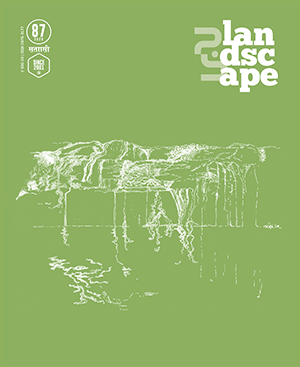
In this issue of the Journal of Landscape Architecture, the mythical “Paradise”, or Nandanvan, is viewed as a metaphor for a beautiful life on this planet. By deconstructing its exclusivity, we seek to unfold its meaning for the everyday lives of all living beings, as examined by the invited authors through their respective lenses.
Today, our experience of life has become far too entangled in mechanistic ways of conceiving, imagining, creating, and living. Increasingly large areas of land are occupied by buildings and infrastructure, leaving little space for the order of Nature. Land itself seems to have been hijacked by commerce. The consequences are reflected in the way neighbourhoods, towns, and cities are planned, expanded, and juxtaposed according to the peculiar rationale of infrastructural services.
Perhaps, somewhere along the way, we have lost sight of the most essential truth—that life is fundamentally interconnected and characterised by dependent arising. The anthropocentric view of the world shows humans bestowing upon themselves the authority to rule the planet Earth, to suit their own needs and ambitions, and to dictate the fate of other life forms by placing themselves at the centre of consciousness. However, the evolving universe has its own order, that is one that human beings have not yet fully understood. |